
Boom! This is Books & Biceps #402!
Thanks to everyone who has shared this newsletter with a buddy or fellow sophisticated meathead. We’re now 30,000 strong! In fact, if an awesome B&B reader shared this with you, add your e-mail with the subscribe button below:
BOOKS

My buddy Craig Fehrman’s new book, This Vast Enterprise, is more than a book - it’s an achievement. And I’m not gassing him up because he’s a longtime Books & Biceps reader… I’m saying his book is an achievement because I know how hard it is to write a single biography and story, and with Vast, Craig manages to weave in nearly a dozen, from Meriwether Lewis and William Clark to York, Sacajawea, John Ordway, Black Buffalo, Thomas Jefferson and more. Not to mention he describes traveling routes, towns and cities, the various Indian tribes and the topography from the early 1800s with precision.
I’m telling you, the level of difficulty writing something like this, with dozens of 200+ year old journals and interviews and research catalogues is so high. And he pulls it off using new research and a unique storytelling device, dedicating chapters to different individuals as the historic expedition moves its way westward across the continent.
I’ve long been fascinated with the idea of the famed Corp of Discovery. From our modern lives, the entire adventure seems almost impossible. Physically. Mentally. All of it. The sheer mechanics of moving all of their gear and boats and supplies upriver and over land with mostly manpower is crazy. Years on end of brutal days, tough sleeping conditions, potential attacks, navigating rivers, weather, mountains, bugs and more. It boggles the mind. And yet, they did it. I’ve loved this adventure story since I first learned about it in school and I loved this book. And I’m pumped that Craig agreed to an exclusive B&B interview with us. I went deep on some of these, so read this and then grab your copy here. Let’s help give this book the awesome launch it deserves:
FINKEL: Let’s start with the workhorse himself, John Ordway. There’s a scene you describe in the book, where the expedition is hauling a heavy canoe upriver towards the Rockies. The men have been traveling well over a year. They are waist deep in freezing water. Their feet are bare and bloody from the rocks in the riverbed. They’re exhausted. Mosquitos and flies attack their bodies above water. And yet, they pull. Day after day. Ordway became the leader of what I’d call the working men in the group. What level of grit did this man have to do all the grunt work while also acting as a go-between for Lewis & Clark? He seemed to have an incredible tolerance for pain, as they all did.
FEHRMAN: With each person in this book, I tried to find one idea or one line to guide me. For Ordway it was this quote from his journal: “I am full of pains, but not very sick.” That really sums it up, right? I am absolutely wrecked with pain, but other than that, I'm good. He was so tough for the reasons you mentioned. They all were. But Ordway carried an extra burden because he was a sergeant. Any good NCO has to be the buffer between the soldiers and the officers. For Ordway this started during the first winter, right outside St. Louis. Some of the civilians were still learning how to be soldiers. Ordway basically put them through boot camp. At one point, Ordway gave an order to a private named John Colter. Colter said he was going to kill Ordway. He started loading his rifle in front of the other men. Ordway stood his ground, but he didn't overreact. The captains eventually got everyone under control, and a few weeks later, when Colter got to pick the squad he would serve in, he picked Ordway's. They were heading on this wild and dangerous journey, but Colter wanted the guy he'd threatened to be his sergeant, and that tells you everything about the kind of man Ordway was.
FINKEL: In terms of versatility and skills, it seems that York was the MVP of the expedition. He was the biggest and strongest man, could hunt, cook, swim, carry anything and fix anything. That he was Clark’s slave made his involvement and how he carried himself throughout a fascinating part of the story. I know you went into deep research on his life, what others said about him and how he must have felt during different times on the trip, but in fleshing him out as a person, did anything surprise you about his abilities? What impressed you the most about him?
FEHRMAN: I love that you emphasize the stuff York did. His enslavement was brutal, and Clark could be a vicious owner, but I tried to show that York was more than his identity. What surprised me most was how important York was during the worst rapids. This is also a great example of what historical detective work looks like. First, like you said, York was ripped. Clark says this in his journal. Second, he was a fantastic swimmer. Clark says this too. Third, most people in this time period could not swim. A professor wrote a whole book on this. Fourth, I found a new letter from Clark where he said York knows how to manage the boats.
Now, on the Columbia River, they faced terrifying rapids, spraying water, crashing waves, razor sharp rocks. Lewis and Clark decided to divide the men between good swimmers and bad ones. The bad swimmers carried the gear on land. The good ones took the lightened canoes through the rapids. Add these factors up and I believe it's clear that York was in a canoe during these wild stretches, probably sitting near Lewis, which was York's regular spot. He was backpaddling and bracing for impact and screaming "ledge ahead." But they made it through together.
FINKEL: In our modern era of everyone keeping tabs on everything everywhere at any time, the idea that Thomas Jefferson signed off on the expedition and then had no idea when he’d hear from the men or if they’d even survive, is amazing. Jefferson obviously had high hopes for the trip. And the news reports from whenever they wrote were followed closely. But did Jefferson ever think the men were lost for good? There was no back-up. No way to check-in. And how could he trust that any news he heard was legit?
FEHRMAN: In 1804, the expedition was viral news. Think of us all sharing images of Artemis II on social media. The same thing was happening to the expedition. Newspapers would print every rumor, no matter how flimsy. There were stories that Lewis and Clark had been killed by Native people or shipped to China. No one knew the truth, not even the president. One of my favorite sections in This Vast Enterprise zooms in on Ordway's parents. I wanted it to be the 1804 version of the scene you always get in a war movie, where the family is at home, flinching every time there's a knock on the door. Ordway's family lived in New Hampshire, so I read all the newspapers they would have read and tried to recreate what they knew about their son. Speaking of social media, there were junk ads back then too. Anyone want to buy some worm powder?
Here's the thing about Jefferson. He never gave up hope. When Lewis and Clark were nearly home, they ran into fur traders. One trader told them that the expedition had been given up by the people of the United States generally and almost forgotten. But that same trader said the president of the United States had yet hopes of us. Jefferson was right to believe. They made it home.
FINKEL: Lewis getting shot through his butt cheeks by friendly fire on the return trip home was one of the most excruciating things to read in the book, and that’s saying something. The pain. The fevers. The weeks on end in a bumping, rocking, wet boat, only laying on his stomach. I mean, pure torture. How did he survive? It really feels like the infection and conditions should have killed him, right? Pure will?
FEHRMAN: Lewis was a brilliantly stubborn human being. Even when he was a kid in school, one of his classmates called him remarkable for perseverance. During the expedition, he never really stopped. I'm not sure he knew how to. Lewis was constantly falling, constantly getting caught one on one with a grizzly bear. So I think it was pure will, along with some luck. But here's the thing. It caught up to him. Another new thing I found was this letter from John Quincy Adams, who knew Lewis and had dinner with him when he got back from the expedition. Adams had just seen Lewis a couple years before. But look what he wrote. I did not know him again, though I expected to meet him. He looks fifteen years older.
Lewis gave everything to this mission because he believed in it and because he loved his country. But he paid the price.
FINKEL: The mental workload for Clark day-to-day on the expedition was incredible. The charting, the mapping, the specimen-collecting, the writing and on and on. He’d routinely walk 20 and 30 miles a day while doing all of his side-jobs, in addition to managing the expedition and the Indian relations with Lewis. What was in the constitution of these men to handle all of this? The number of different skills and interests to maintain focus, keep journals, copy journals and stay on task is staggering. There’s no modern equivalent, right? We don’t have guys like this anymore, do we?
FEHRMAN: Maybe we still have them, but they do not write history books! It really is incredible what Clark took on, and he paid a price too. During the most stressful periods, he came down with stomach trouble and headaches, but he kept going. I think Clark is underrated as an Enlightenment thinker. He was a bad speller, and scholars love to make fun of that. Honestly, I think it's kind of ridiculous. He didn't have spellcheck. He didn't have air conditioning. And people in 1804 didn't really stress about spelling anyway. I found new proof that Clark went to college, and you can see in his journals that he was quite interested in the Native people he met, their culture, their history, their art.
So let's add anthropologist to his list of duties. And let's end with this:
All of the guys on this expedition were remarkable, a real band of brothers. When one of them died, Charles Floyd, Clark called him our deceased brother. But the Native guys they met were just as remarkable. The Lakota leaders and fighters, for instance, were also a band of brothers. One thing I love about Lewis and Clark is that, like all great stories, it's a story with two sides. I believe my book is the first one that gives readers the whole story.
BICEPS
There’s a man who weighs 435 pounds named Julius Maddox. He currently holds the world record for unassisted bench press at 782 pounds. Obviously, that’s impressive.
But, I came across this video of him training to break the record, and somehow this set he’s doing is more impressive. It’s two sets of 585 pounds, 5 times.
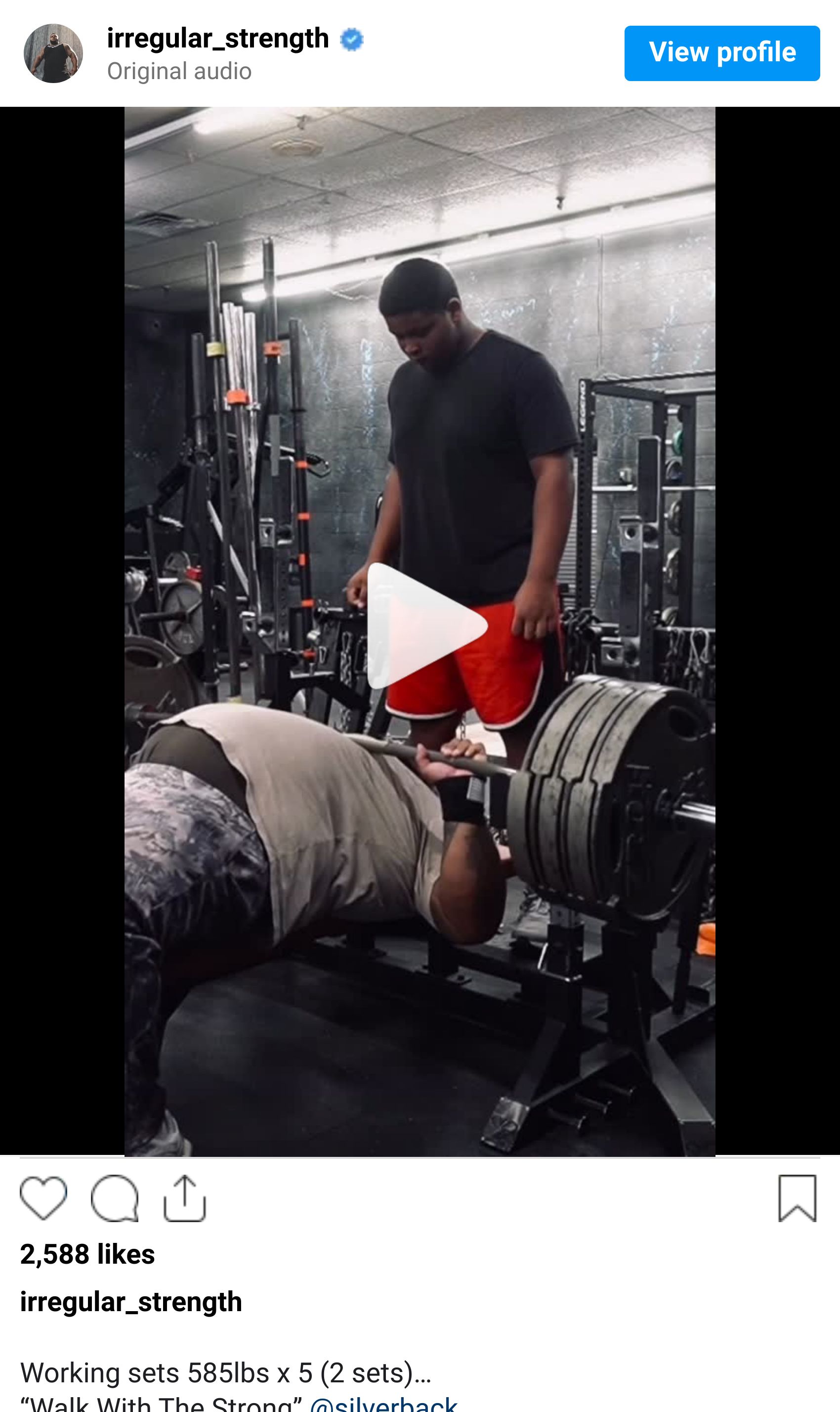
Now, for most dudes who lift a lot, being able to crank out sets of five reps at 275 or 315 is impressive. In fact, I’d say if you’re able to bang out five reps of 275+ you’re in the upper .5 percent of all men in terms of strength. And yes, I mean that, considering probably 75-85% of men don’t lift meaningful weights at all, and of the percent left, another 10% just do circuits or basic rep ranges to maintain strength, and even of the guys who lift a lot, cranking out sets of 275+ puts you in rarified, strong air.
So watching this guy Julius somewhat easily do that with 585 pounds, which is DOUBLE what a genuinely strong lifter is benching, is ludicrous.
STRONG LINKS
If you’re a guy over 40 and you’ve been looking for a new digital magazine that’s written for midlife men, by midlife men, on the topics that actually matter to us: family, fitness, fashion, finance, food & fun, then join us at Midlife Male.
I write a column every Tuesday called The Manologue. This week, I wrote about a subject near and dear to my heart: the guys text chain. In particular, how its the modern day high school football locker room for dudes and it must be protected at all costs. Read this and I promise it’ll feel familiar haha:

WrestleMania is this weekend and it’s the two-year anniversary of our incredible Macho Man book launch:

The book trailer is still one of my all-time favorites:
And the fact that John Cena himself endorsed the book is amazing, ooohhhhh yeahhhh!!!!:

Try One of Our Most Popular B&B Challenges:
P.S. WE’RE 207 DAYS OUT FROM THE RELEASE OF BEAR BRAWL!!!
We’re currently working on the cover and I love this part of the book publishing process. It’s when you first get to envision what the book will look and feel like.
And while the cover reveal is coming soon, you can always pre-order your book right now. We have a TON of cool giveaways coming, so just screenshot your order and you’ll be able to take advantage of every single one:

Jon Finkel is the award-winning author of Macho Man: The Untamed, Unbelievable Life of Randy Savage, 1996: A Biography, Hoops Heist, The Life of Dad, Jocks In Chief, The Athlete, Heart Over Height, “Mean” Joe Greene and more. His books have been endorsed by everyone from Mark Cuban, John Cena and Tony Dungy to Spike Lee, Kevin Durant and Chef Robert Irvine. He has written for GQ, Men’s Health, Yahoo! Sports, The New York Times and has appeared on CBS: This Morning, Good Morning Texas, Good Morning Chicago, and hundreds of radio shows, podcasts and streams. Jon was recently profiled in The New Yorker about the awesome community he’s built around his Books & Biceps newsletter. They describe him as “a gym rat’s Reese Witherspoon”. Reply to this email for any media requests.
Sponsorship Opportunities
→ DO YOU READ BOOKS & BICEPS MOST WEEKS?
→ DO YOU WORK FOR A BRAND OR COMPANY OR SELL A PRODUCT?
Want to get in front of 29,000 awesome readers who focus on being smart, wellness, fitness, nutrition, entertainment, sports and more?
You could be our next title sponsor! Previous sponsors include Nike, Random House, Netflix, Huel, HubSpot, SFH Nutrition, La Touraine Watches and more…